CBS 2019


CBSMD教育中心


HOME


CBS 2019
At CBS


General Information
Association and Affiliations
Organized by
Nanjing Heart Center
Asian Bifurcation Club (ABC)
Nanjing First Hospital, Nanjing Medical University
Co-organized by
Chinese Society of Cardiology (CSC)
Capacity Building and Continuing Education Center,National Health and Family Planning Commission (CBCEC)
American Society for Cardiovascular Angiography and Interventions (SCAI)
Asian Heart Society (AHS)
Contact Us
Registration Administration of Domestic Representatives
Hongjuan Peng : +86-13913895477
Haimei Xu +86-13914736846
 cbsnj@cbsmd.cn
Registration Administration of Overseas Representatives
Ling Lin : +86 (25) 52271398
+86-13951884596
cbs@cbsmd.cn
Management of Challenging Cases
Yingying Zhao :+86-13815408517
sub@cbsmd.cn
Address
 CBS2019 Congress Secretariat, Nanjing First Hospital, Building No.9 68# Changle Road, Nanjing, China
 210006


FACULTY
FACULTY
General Chairman
Congress Chairman


Education Center
Education Center
• Online Education (For more customized user interface with self-defined collection of research papers and education resources.)
• CBS Education Resource


• CBSMD Scientific Library


SCIENTIFIC LIBRARY
SCIENTIFIC LIBRARY


Research Paper
> Acute Coronary Syndrom
> ASCVD Prevention
> Bifurcation Stenting
> Cardio-Oncology
> Congestive Heart Failure
> DAPT Duration
> Drug Coated Balloon
> Fractional Flow Reserve
> IVUS Guidance
> Optical Coherence Tomography
> Pulmonary Hypertension
> Rotational Atherectomy
> Shear Stress
> Stenting Left Main
> Transcatheter Aortic Valve Replacement
> Percutaneous LAA Occlusion
> Mitral/Tricuspid Valvular Disease
> Other Relevant Articles
Recommended Paper
Management of Acute Myocardial Infarction During the COVID-19 Pandemic
COVID-19 and Thrombotic or Thromboembolic Disease: Implications for Prevention, Antithrombotic Therapy, and Follow-up
CSC Expert Consensus on Principles of Clinical Management of Patients with Severe Emergent Cardiovascular Diseases during the COVID-19 Epidemic
ACC Clinical Bulletin Focuses on Cardiac Implications of Coronavirus (COVID-19)
血流储备分数
Original Research
JOURNAL:CBS2017 Article Link
CBS2017 Keywords: CBS Insight; Gary Mintz; IVUS; OCT; vulnerable plaque; BRS

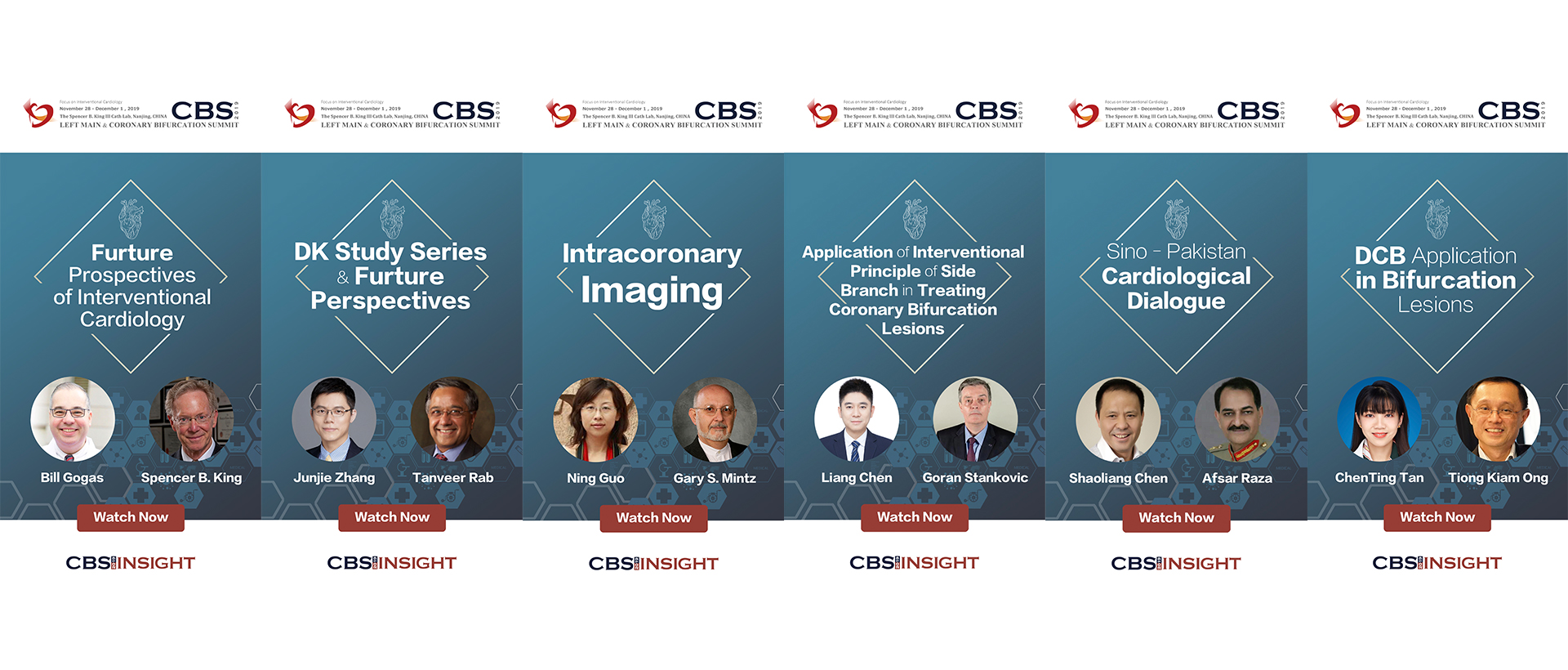
CBS Insight interviewed Prof Gary S. Mintz at CBS2017
Biography
Dr. Gary S. Mintz is chief medical officer of the Cardiovascular Research Foundation, an independent, academically focused nonprofit organization dedicated to improving the survival and quality of life for people with cardiovascular disease through research and education, editor-in-chief of TCTMD.com, and a co-director of Transcatheter Cardiovascular Therapeutics (TCT). Dr. Mintz has extensive experience in both interventional cardiology and cardiac ultrasound and is an expert in the area of cardiovascular imaging. He joined the Cardiovascular Research Foundation in 1991 as director of the Coronary Ultrasound Program, which has studied over 30,000 patients using intravascular ultrasound and has made fundamental observations about the pathology, pathogenesis, and mechanisms of coronary atherosclerosis, catheter-based interventions, and restenosis. He is the author of over 675 articles, 50 book chapters, and 625 abstracts concerning various aspects of clinical cardiology, cardiac ultrasound, hemodynamics, cardiac radiology and coronary arteriography, interventional cardiology, and intravascular ultrasound. In 2005, Dr. Mintz published the single-authored textbook Intracoronary Ultrasound, the definitive work in the field. Dr. Mintz completed his undergraduate education at the University of Pennsylvania in 1970 and received his medical degree from Hahnemann University, in 1974, both in Philadelphia, Pennsylvania. He finished his internship in 1975, residency in 1976, and cardiology fellowship in 1978, each at Hahnemann University. He joined the Hahnemann University Department of Medicine faculty (with a joint appointment in the Department of Diagnostic Radiology) in 1978 and was ultimately promoted to professor of medicine in 1987. His administrative appointments there included director of the Cardiac Ultrasound Laboratory, director of the Coronary Care Unit, and director of the Cardiology Fellowship Training Program. He received teaching awards from both the department of medicine residency and cardiology fellowship training programs.
Remarks
Date of this Interview: Dec 1st, 2017
This
video is intended for professional use only by physicians and is not intented
for reposting or redistribution on other external channels.
Caution:
This product is intended for use by or under the direction of a physician.
Prior to use, reference CBS2017.
www.cbs2017.org. All rights reserved.


 中 文
中 文




 CBS 2019
 CBS 2019 FACULTY
 Education Resource
 CBSMD Scientific Library


