CBS 2019


CBSMD教育中心


HOME


CBS 2019
At CBS


General Information
Association and Affiliations
Organized by
Nanjing Heart Center
Asian Bifurcation Club (ABC)
Nanjing First Hospital, Nanjing Medical University
Co-organized by
Chinese Society of Cardiology (CSC)
Capacity Building and Continuing Education Center,National Health and Family Planning Commission (CBCEC)
American Society for Cardiovascular Angiography and Interventions (SCAI)
Asian Heart Society (AHS)
Contact Us
Registration Administration of Domestic Representatives
Hongjuan Peng : +86-13913895477
Haimei Xu +86-13914736846
 cbsnj@cbsmd.cn
Registration Administration of Overseas Representatives
Ling Lin : +86 (25) 52271398
+86-13951884596
cbs@cbsmd.cn
Management of Challenging Cases
Yingying Zhao :+86-13815408517
sub@cbsmd.cn
Address
 CBS2019 Congress Secretariat, Nanjing First Hospital, Building No.9 68# Changle Road, Nanjing, China
 210006


FACULTY
FACULTY
General Chairman
Congress Chairman


Education Center
Education Center
• Online Education (For more customized user interface with self-defined collection of research papers and education resources.)
• CBS Education Resource


• CBSMD Scientific Library


SCIENTIFIC LIBRARY
SCIENTIFIC LIBRARY


Research Paper
> Acute Coronary Syndrom
> ASCVD Prevention
> Bifurcation Stenting
> Cardio-Oncology
> Congestive Heart Failure
> DAPT Duration
> Drug Coated Balloon
> Fractional Flow Reserve
> IVUS Guidance
> Optical Coherence Tomography
> Pulmonary Hypertension
> Rotational Atherectomy
> Shear Stress
> Stenting Left Main
> Transcatheter Aortic Valve Replacement
> Percutaneous LAA Occlusion
> Mitral/Tricuspid Valvular Disease
> Other Relevant Articles
Recommended Paper
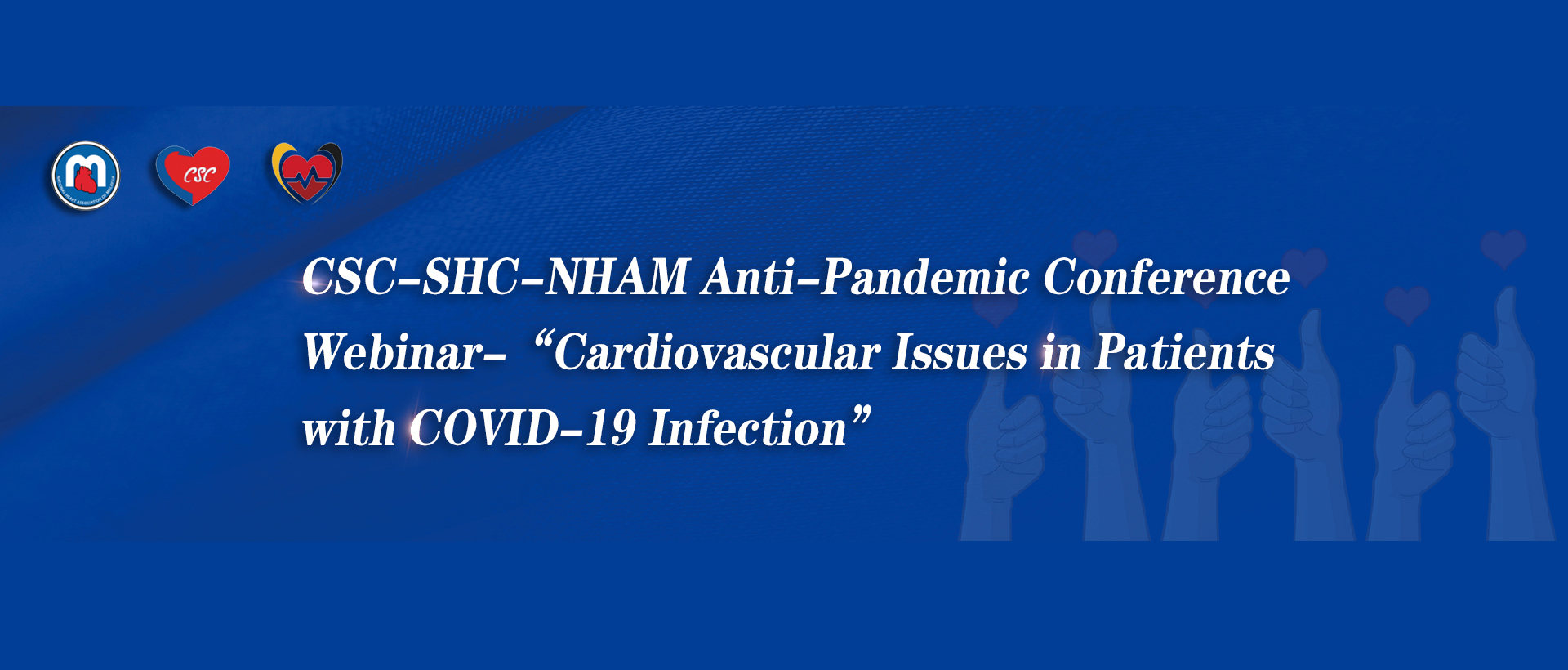
Management of Acute Myocardial Infarction During the COVID-19 Pandemic
COVID-19 and Thrombotic or Thromboembolic Disease: Implications for Prevention, Antithrombotic Therapy, and Follow-up
CSC Expert Consensus on Principles of Clinical Management of Patients with Severe Emergent Cardiovascular Diseases during the COVID-19 Epidemic
ACC Clinical Bulletin Focuses on Cardiac Implications of Coronavirus (COVID-19)
血流动力学与动脉粥样硬化
Original Research2019 Feb;67(2):284-291.
JOURNAL:J Am Geriatr Soc. Article Link
Goyal P, Bryan J, Kneifati-Hayek J et al. Keywords: functional impairment; heart failure; polypharmacy
OBJECTIVES - To determine whether the number of medications taken by adults with heart failure (HF) and impairment in activities of daily living (ADL)-a subpopulation in whom the risks of a high medication burden may outweigh the benefits-differs from the number taken by those without impairment in ADLs.
DESIGN - Cross-sectional.
SETTING - National Health and Nutrition Examination Survey (NHANES; 2003-2014), a cross-sectional survey that produces national estimates of adults in the United States.
PARTICIPANTS - Adults aged 50 and older (mean 70) with self-reported HF (N= 947; representing 4.6 million adults with HF in the United States.
MEASURMENTS - We assessed ADL impairment and medication count based on self-report. ADL impairment was defined as having difficulty with or being unable to dress, feed oneself, or get in and out of bed. To determine the independent association between ADL impairment and medication count, we performed sequential Poisson multivariable regression analyses. All analyses were cross-sectional in nature and accounted for the complex survey design of NHANES.
RESULTS - Mean medication count was 7.2, and 74% of participants were taking 5 or more medications (polypharmacy). In a multivariable model, ADL impairment was not independently associated with medication count. These findings were similar for those with 3 or more hospitalizations in the prior year, declining health status, and cognitive impairment.
CONCLUSION - After adjusting for confounders including comorbidity, we found that adults with HF and ADL impairment take as many medications as those without ADL impairment. This suggests that providers may not sufficiently consider functional impairment when prescribing medications to adults with HF and thus may unnecessarily expose individuals to risk of adverse outcomes. J Am Geriatr Soc 67 : 284-291, 2019.
© 2018, Copyright the Authors Journal compilation © 2018, The American Geriatrics Society.


 中 文
中 文




 CBS 2019
 CBS 2019 FACULTY
 Education Resource
 CBSMD Scientific Library


