CBS 2019


CBSMD教育中心


HOME


CBS 2019
At CBS


General Information
Association and Affiliations
Organized by
Nanjing Heart Center
Asian Bifurcation Club (ABC)
Nanjing First Hospital, Nanjing Medical University
Co-organized by
Chinese Society of Cardiology (CSC)
Capacity Building and Continuing Education Center,National Health and Family Planning Commission (CBCEC)
American Society for Cardiovascular Angiography and Interventions (SCAI)
Asian Heart Society (AHS)
Contact Us
Registration Administration of Domestic Representatives
Hongjuan Peng : +86-13913895477
Haimei Xu +86-13914736846
 cbsnj@cbsmd.cn
Registration Administration of Overseas Representatives
Ling Lin : +86 (25) 52271398
+86-13951884596
cbs@cbsmd.cn
Management of Challenging Cases
Yingying Zhao :+86-13815408517
sub@cbsmd.cn
Address
 CBS2019 Congress Secretariat, Nanjing First Hospital, Building No.9 68# Changle Road, Nanjing, China
 210006


FACULTY
FACULTY
General Chairman
Congress Chairman


Education Center
Education Center
• Online Education (For more customized user interface with self-defined collection of research papers and education resources.)
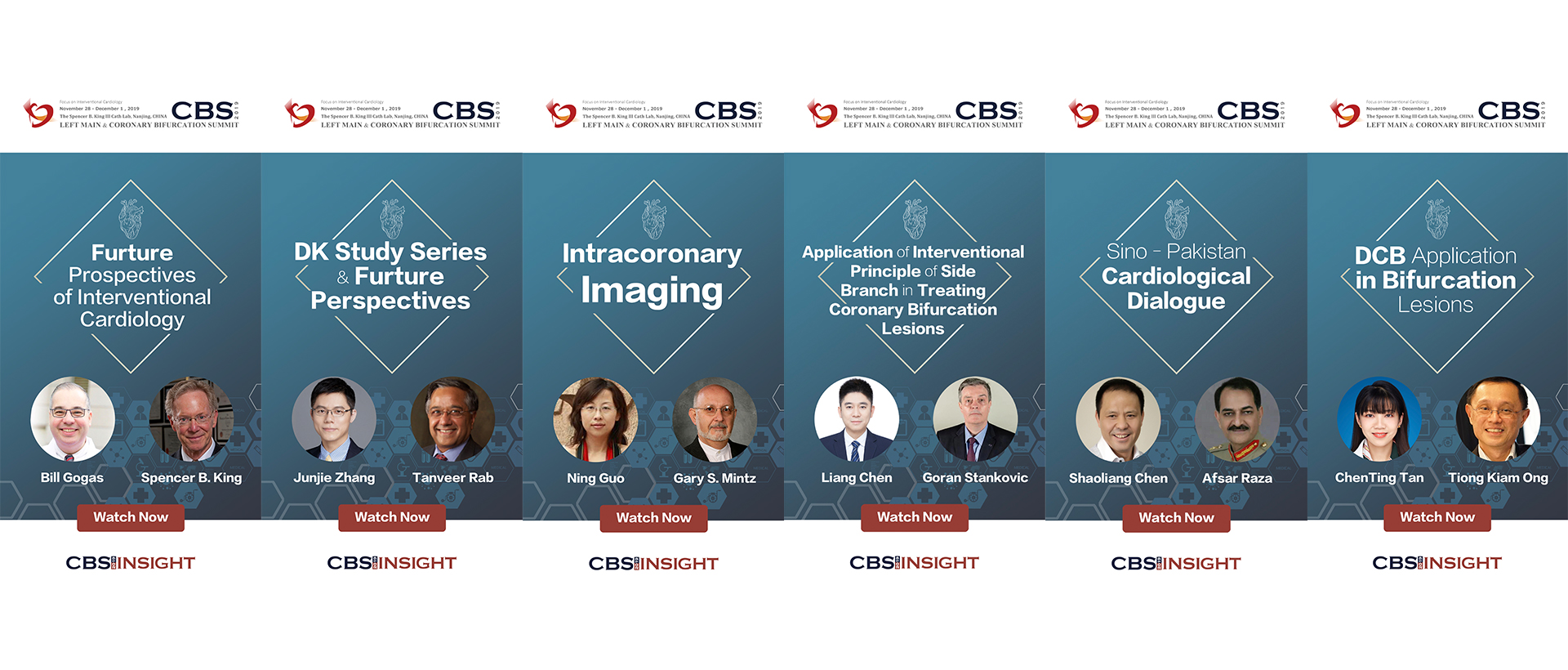
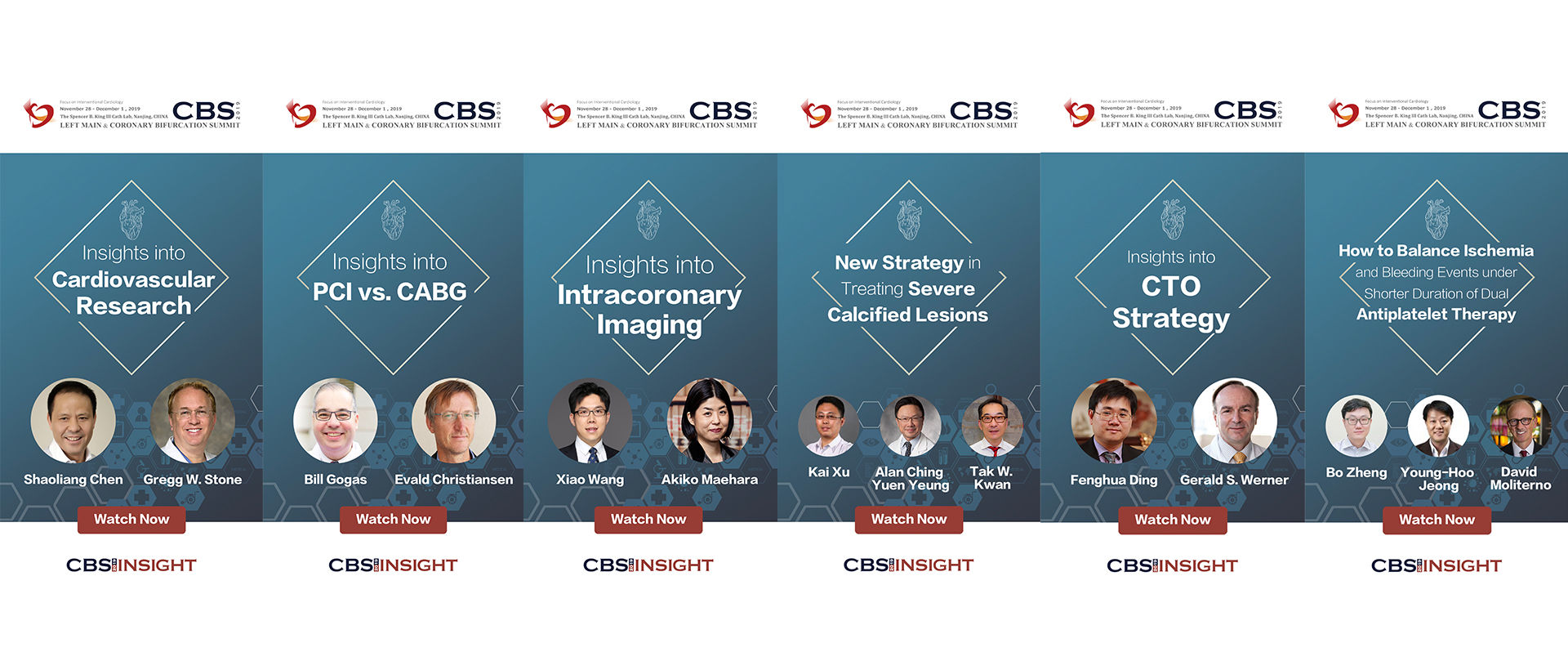
• CBS Education Resource


• CBSMD Scientific Library


SCIENTIFIC LIBRARY
SCIENTIFIC LIBRARY


Research Paper
> Acute Coronary Syndrom
> ASCVD Prevention
> Bifurcation Stenting
> Cardio-Oncology
> Congestive Heart Failure
> DAPT Duration
> Drug Coated Balloon
> Fractional Flow Reserve
> IVUS Guidance
> Optical Coherence Tomography
> Pulmonary Hypertension
> Rotational Atherectomy
> Shear Stress
> Stenting Left Main
> Transcatheter Aortic Valve Replacement
> Percutaneous LAA Occlusion
> Mitral/Tricuspid Valvular Disease
> Other Relevant Articles
Recommended Paper
Management of Acute Myocardial Infarction During the COVID-19 Pandemic
COVID-19 and Thrombotic or Thromboembolic Disease: Implications for Prevention, Antithrombotic Therapy, and Follow-up
CSC Expert Consensus on Principles of Clinical Management of Patients with Severe Emergent Cardiovascular Diseases during the COVID-19 Epidemic
ACC Clinical Bulletin Focuses on Cardiac Implications of Coronavirus (COVID-19)
Percutaneous LAA Occlusion
Original Research
JOURNAL:ACC Article Link
CBSMD
房颤(Atrial fibrillation, AF)和慢性肾脏疾病( chronic kidney disease ,CKD)的多种致病因素常存在共通性,如高血压、糖尿病和冠状动脉疾病。当不合并CKD时,对房颤患者开展抗凝治疗是毋庸置疑的,但此做法不适用于房颤合并晚期CKD的患者群(advanced CKD)。随着CKD患者肾功能的下降,缺血性卒中和出血的危险逐渐增加,使抗凝治疗趋向复杂。现存随机对照试验尚不能得出可明确辅助临床决策的指南性意见,而观察性研究的结果相互矛盾。在最新JACC综述“Anticoagulation in Concomitant Chronic Kidney Disease and Atrial Fibrillation: JACC Review Topic of the Week”中,作者概述了相关病理生理学机制,总结CKD合并AF的抗凝策略及研究进展, 并就如何在这些患者中使用口服抗凝给出建议。
该文核心要点可参阅CBSMD文献导读“Anticoagulation in Concomitant CKD and AF”。


 中 文
中 文




 CBS 2019
 CBS 2019 FACULTY
 Education Resource
 CBSMD Scientific Library


