CBS 2019


CBSMD教育中心


HOME


CBS 2019
At CBS


General Information
Association and Affiliations
Organized by
Nanjing Heart Center
Asian Bifurcation Club (ABC)
Nanjing First Hospital, Nanjing Medical University
Co-organized by
Chinese Society of Cardiology (CSC)
Capacity Building and Continuing Education Center,National Health and Family Planning Commission (CBCEC)
American Society for Cardiovascular Angiography and Interventions (SCAI)
Asian Heart Society (AHS)
Contact Us
Registration Administration of Domestic Representatives
Hongjuan Peng : +86-13913895477
Haimei Xu +86-13914736846
 cbsnj@cbsmd.cn
Registration Administration of Overseas Representatives
Ling Lin : +86 (25) 52271398
+86-13951884596
cbs@cbsmd.cn
Management of Challenging Cases
Yingying Zhao :+86-13815408517
sub@cbsmd.cn
Address
 CBS2019 Congress Secretariat, Nanjing First Hospital, Building No.9 68# Changle Road, Nanjing, China
 210006


FACULTY
FACULTY
General Chairman
Congress Chairman


Education Center
Education Center
• Online Education (For more customized user interface with self-defined collection of research papers and education resources.)
• CBS Education Resource


• CBSMD Scientific Library


SCIENTIFIC LIBRARY
SCIENTIFIC LIBRARY


Research Paper
> Acute Coronary Syndrom
> ASCVD Prevention
> Bifurcation Stenting
> Cardio-Oncology
> Congestive Heart Failure
> DAPT Duration
> Drug Coated Balloon
> Fractional Flow Reserve
> IVUS Guidance
> Optical Coherence Tomography
> Pulmonary Hypertension
> Rotational Atherectomy
> Shear Stress
> Stenting Left Main
> Transcatheter Aortic Valve Replacement
> Percutaneous LAA Occlusion
> Mitral/Tricuspid Valvular Disease
> Other Relevant Articles
Recommended Paper
Management of Acute Myocardial Infarction During the COVID-19 Pandemic
COVID-19 and Thrombotic or Thromboembolic Disease: Implications for Prevention, Antithrombotic Therapy, and Follow-up
CSC Expert Consensus on Principles of Clinical Management of Patients with Severe Emergent Cardiovascular Diseases during the COVID-19 Epidemic
ACC Clinical Bulletin Focuses on Cardiac Implications of Coronavirus (COVID-19)
科学研究
Clinical TrialVolume 70, Issue 15, October 2017
JOURNAL:J Am Coll Cardiol. Article Link
Giustino G, Mehran R, Stone GW et al. Keywords: ST-segment elevation myocardial infarction; average daily rate; bleeding events; ischemic events; percutaneous coronary intervention
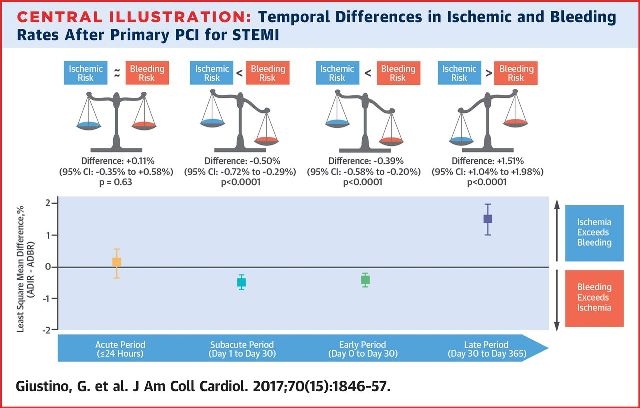
BACKGROUND - The risk of recurrent ischemic and bleeding events after primary percutaneous coronary intervention (PCI) for ST-segment elevation myocardial infarction (STEMI) may not be uniform over time, which may affect the benefit-to-risk ratio of guideline-recommended antithrombotic therapies in different intervals.
OBJECTIVES - This study sought to characterize the average daily ischemic rates (ADIRs) and average daily bleeding rates (ADBRs) within the first year after primary PCI for STEMI.
METHODS - Among 3,602 patients with STEMI who were enrolled in the HORIZONS-AMI (Harmonizing Outcomes with Revascularization and Stents in Acute Myocardial Infarction) trial, all ischemic and bleeding events, including recurrent events, were classified according to the timing of their occurrence as acute (≤24 h after PCI), subacute (1 day to 30 days), and late (30 days to 1 year). Patients were treated with aspirin and clopidogrel for the entire year. ADIRs included cardiac death, reinfarction, and definite stent thrombosis. ADBRs included non–coronary artery bypass graft–related Thrombolysis In Myocardial Infarction major and minor bleeding. ADIRs and ADBRs were calculated as the total number of events divided by the number of patient-days of follow-up in each interval assuming a Poisson distribution. Generalized estimating equations were used to test the absolute least square mean differences (LSMD) between ADIRs and ADBRs.
RESULTS- The ADIR and ADBR both exponentially decreased from the acute to the late periods (p < 0.0001). Although there were no significant differences in ADIR and ADBR in the acute phase (LSMD: +0.11%; 95% confidence interval [CI]: −0.35% to 0.58%; p = 0.63), the ADBR was greater than the ADIR in the subacute phase (LSMD: −0.39%; 95% CI: −0.58% to −0.20%; p < 0.0001). In the late phase, the ADIR exceeded the ADBR (LSMD: +1.51%; 95% CI: 1.04% to 1.98%; p < 0.0001).
CONCLUSIONS - After primary PCI, the ADIR and ADBR both markedly decreased over time. Although the rates for bleeding exceeded those for ischemia within 30 days, the daily risk of ischemia significantly exceeded the daily risk of bleeding beyond 30 days, supporting the use of intensified platelet inhibition during the first year after STEMI.


 中 文
中 文




 CBS 2019
 CBS 2019 FACULTY
 Education Resource
 CBSMD Scientific Library


