CBS 2019


CBSMD教育中心


HOME


CBS 2019
At CBS


General Information
Association and Affiliations
Organized by
Nanjing Heart Center
Asian Bifurcation Club (ABC)
Nanjing First Hospital, Nanjing Medical University
Co-organized by
Chinese Society of Cardiology (CSC)
Capacity Building and Continuing Education Center,National Health and Family Planning Commission (CBCEC)
American Society for Cardiovascular Angiography and Interventions (SCAI)
Asian Heart Society (AHS)
Contact Us
Registration Administration of Domestic Representatives
Hongjuan Peng : +86-13913895477
Haimei Xu +86-13914736846
 cbsnj@cbsmd.cn
Registration Administration of Overseas Representatives
Ling Lin : +86 (25) 52271398
+86-13951884596
cbs@cbsmd.cn
Management of Challenging Cases
Yingying Zhao :+86-13815408517
sub@cbsmd.cn
Address
 CBS2019 Congress Secretariat, Nanjing First Hospital, Building No.9 68# Changle Road, Nanjing, China
 210006


FACULTY
FACULTY
General Chairman
Congress Chairman


Education Center
Education Center
• Online Education (For more customized user interface with self-defined collection of research papers and education resources.)
• CBS Education Resource


• CBSMD Scientific Library


SCIENTIFIC LIBRARY
SCIENTIFIC LIBRARY


Research Paper
> Acute Coronary Syndrom
> ASCVD Prevention
> Bifurcation Stenting
> Cardio-Oncology
> Congestive Heart Failure
> DAPT Duration
> Drug Coated Balloon
> Fractional Flow Reserve
> IVUS Guidance
> Optical Coherence Tomography
> Pulmonary Hypertension
> Rotational Atherectomy
> Shear Stress
> Stenting Left Main
> Transcatheter Aortic Valve Replacement
> Percutaneous LAA Occlusion
> Mitral/Tricuspid Valvular Disease
> Other Relevant Articles
Recommended Paper
Management of Acute Myocardial Infarction During the COVID-19 Pandemic
COVID-19 and Thrombotic or Thromboembolic Disease: Implications for Prevention, Antithrombotic Therapy, and Follow-up
CSC Expert Consensus on Principles of Clinical Management of Patients with Severe Emergent Cardiovascular Diseases during the COVID-19 Epidemic
ACC Clinical Bulletin Focuses on Cardiac Implications of Coronavirus (COVID-19)
Stenting Left Main
Original Research2017 Nov 14;70(20):2476-2486.
JOURNAL:J Am Coll Cardiol. Article Link
Shah KS, Xu H, Fonarow GC et al. Keywords: ejection fraction; heart failure; outcomes; survival
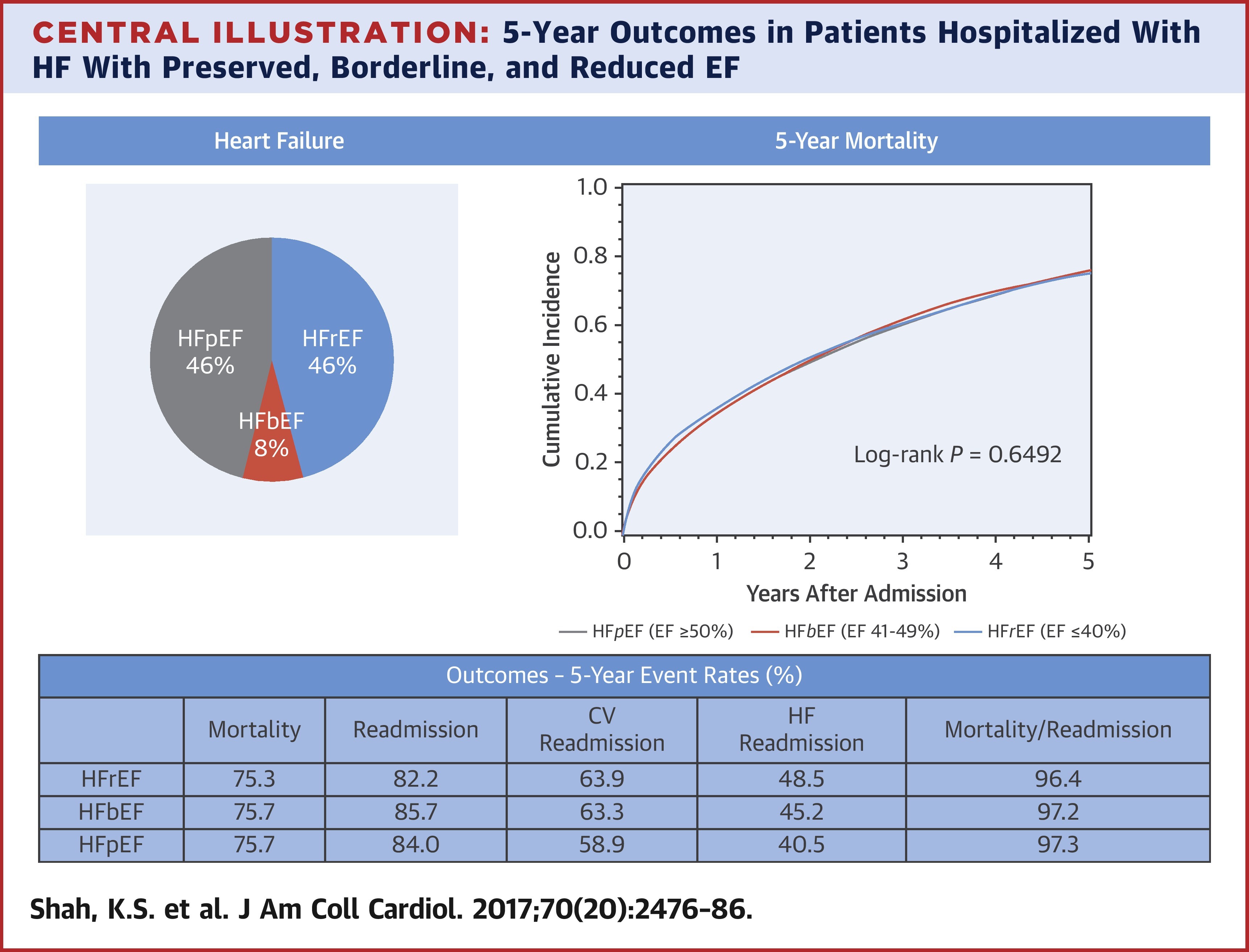
BACKGROUND - Patients with heart failure (HF) have a poor prognosis and are categorized by ejection fraction (EF).
OBJECTIVES - This study sought to characterize differences in outcomes in patients hospitalized with heart failure with preserved ejection fraction (HFpEF) (EF ≥50%), heart failure with borderline ejection fraction (HFbEF) (EF 41% to 49%), and heart failure with reduced ejection fraction (HFrEF) (EF ≤40%).
METHODS - Data from GWTG-HF (Get With The Guidelines-Heart Failure) were linked to Medicare data for longitudinal follow-up. Multivariable models were constructed to examine 5-year outcomes and to compare survival to median survival of the U.S. population.
RESULTS - A total of 39,982 patients from 254 hospitals who were admitted for HF between 2005 and 2009 were included: 18,299 (46%) had HFpEF, 3,285 (8.2%) had HFbEF, and 18,398 (46%) had HFrEF. Overall, median survival was 2.1 years. In risk-adjusted survival analysis, all 3 groups had similar 5-year mortality (HFrEF 75.3% vs. HFpEF 75.7%; hazard ratio: 0.99 [95% confidence interval: 0.958 to 1.022]; HFbEF 75.7% vs. HFpEF 75.7%; hazard ratio: 0.99 [95% confidence interval: 0.947 to 1.046]). In risk-adjusted analyses, the composite of mortality and rehospitalization was similar for all subgroups. Cardiovascular and HF readmission rates were higher in those with HFrEF and HFbEF compared with those with HFpEF. When compared with the U.S. population, HF patients across all age and EF groups had markedly lower median survival.
CONCLUSIONS - Among patients hospitalized with HF, patients across the EF spectrum have a similarly poor 5-year survival with an elevated risk for cardiovascular and HF admission. These findings underscore the need to improve treatment of patients with HF.
Copyright © 2017 American College of Cardiology Foundation. Published by Elsevier Inc. All rights reserved.


 中 文
中 文




 CBS 2019
 CBS 2019 FACULTY
 Education Resource
 CBSMD Scientific Library


