CBS 2019


CBSMD教育中心


首页


CBS 2019
关于CBS


会议通知
会议组织
主办单位
南京市心血管病医院
亚洲分叉病变俱乐部
南京医科大学附属南京医院
南京市第一医院医学发展医疗救助基金会
协办单位
中华医学会心血管病学分会
国家卫生健康委能力建设和继续教育心血管病学专家委员会(CBCEC)
美国心血管造影和介入学会
亚洲心脏学会
北京合众关爱心脏健康基金会
联系我们
境内代表注册管理:
彭红娟 : +86-13913895477
徐海梅 :+86-13914736846
 cbsnj@cbsmd.cn
境外代表注册管理:
林玲 : +86 (25) 52271398
+86-13951884596
cbs@cbsmd.cn
病例征集管理:
赵莹莹 :+86-13815408517
sub@cbsmd.cn
地址:
 江苏省南京市秦淮区长乐路68号,南京市心血管病医院9号楼905区心内科办公室
 210006


主席团
主席团
大会主席
联合主席


教育中心
教育中心
• 线上教育 ( 注册后可使用个人定义界面搜集科研图书馆文献、下载教育资源、参与在线病例讨论。)
• 教育资源


• 科研动态


科研图书馆
科研图书馆


科研文章
> 急性冠脉综合征
> 动脉粥样硬化性心血管疾病
> 分叉支架
> 心脏肿瘤科
> 充血性心力衰竭
> 双重抗血小板治疗持续时间
> 药物涂层球囊
> 血流储备分数
> 血管内超声指导
> 光学相关断层扫描
> 肺动脉高压
> 旋磨术
> 血流动力学与动脉粥样硬化
> 左主干支架
> 经导管主动脉瓣置换
> 经皮左心耳封堵
> 二尖瓣/三尖瓣瓣膜
> 推荐文献
荐读文献
Management of Acute Myocardial Infarction During the COVID-19 Pandemic
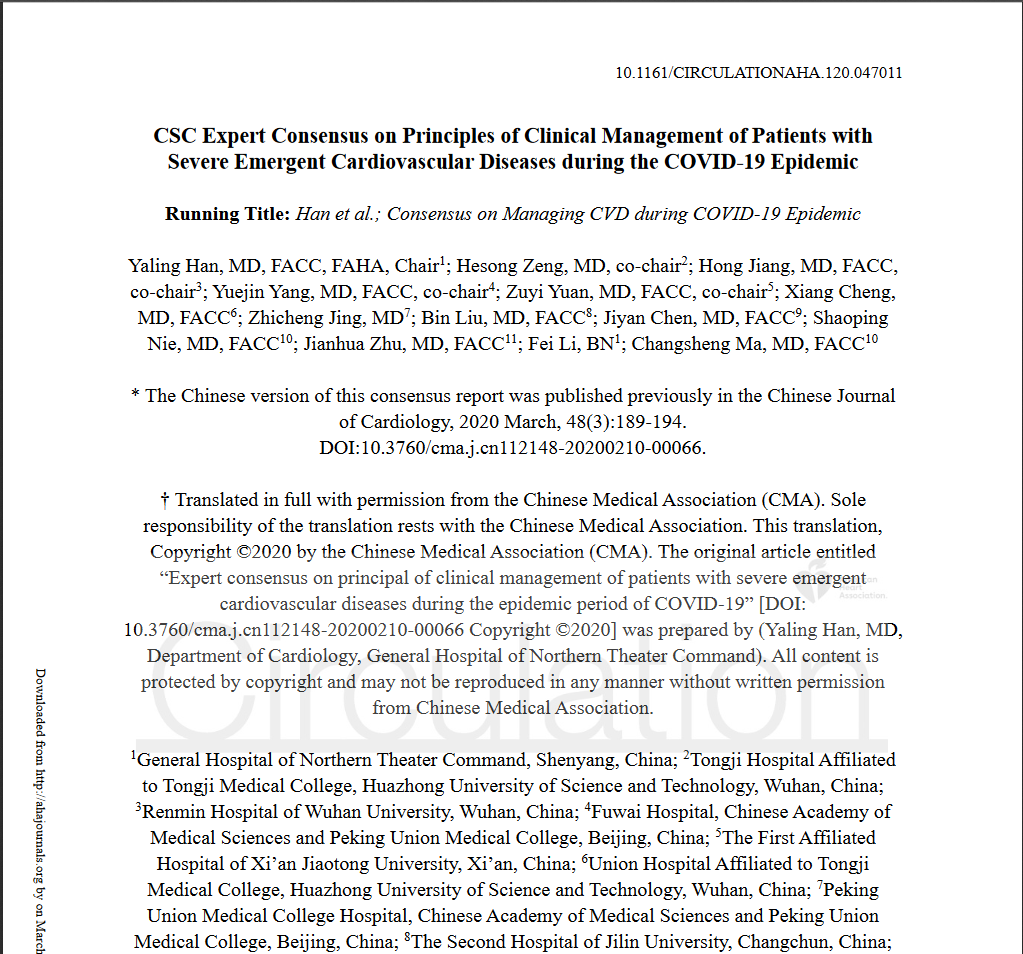
CSC Expert Consensus on Principles of Clinical Management of Patients with Severe Emergent Cardiovascular Diseases during the COVID-19 Epidemic
ACC临床简报:新型冠状病毒对心脏的影响(2019-nCoV)
SCAI Expert Consensus Statement Update on Best Practices for Transradial Angiography and Intervention
科学研究
Original ResearchNovember 2017, Volume 6, Issue 11
JOURNAL:J Am Heart Assoc. Article Link
Minami Y, Wang Z, Jang IK et al. Keywords: atherosclerosis; coronary artery disease; fibrous cap; optical coherence tomography; statin therapy
BACKGROUND - Previous studies have demonstrated that statin therapy improves cardiac outcomes, probably by stabilizing thin-cap fibroatheroma in patients with coronary artery disease. However, major adverse cardiac events still occur in some patients, despite statin therapy. The aim of this study is to identify clinical predictors for the lack of a favorable vascular response to statin therapy in patients with coronary artery disease.
METHODS AND RESULTS - A total of 140 nonculprit plaques from 84 patients with coronary artery disease who were treated with a statin and had serial optical coherence tomography imaging (median interval, 6.3 months) were included. Thin-cap area (fibrous cap thickness, <200 μm) was measured using a novel 3-dimensional computer-aided algorithm. Overall, the thin-cap area significantly decreased from baseline (median, 2.852 mm2; 25th-75th percentile, 1.023-6.157 mm2) to follow-up (median, 1.210 mm2; 25th-75th percentile, 0.250-3.192 mm2; P<0.001), and low-density lipoprotein cholesterol significantly decreased from baseline (mean±SD, 92.9±30.1 mg/dL) to follow-up (mean±SD, 76.3±23.3 mg/dL; P<0.001). The general linear model with multiple predictor variables revealed that the thin-cap area was significantly higher in patients with chronic kidney disease than in those without it (regression coefficient b, 1.691 mm2; 95% confidence interval, 0.350-3.033 mm2; P=0.013) and lower in patients with acute coronary syndrome (regression coefficient b, -1.535 mm2; 95% confidence interval, -2.561 to -0.509 mm2; P=0.003).
CONCLUSIONS - Chronic kidney disease is an independent predictor for the lack of a favorable vascular response to statin therapy, whereas acute coronary syndrome is an independent predictor for favorable vascular response to statin therapy. These findings should be further warranted in future prospective studies.
CLINICAL TRIAL REGISTRATION - URL: http://www.clinicaltrials.gov. Unique identifier: NCT01110538.
© 2017 The Authors. Published on behalf of the American Heart Association, Inc., by Wiley.


 English






 CBS 2019
 CBS 2019 主席团
 教育中心
教育中心 科研动态
科研动态


